
A Guide to Annulment of Marriage in Singapore
Published on: 29 July 2026 | Modified on: 05 August 2026An annulment retroactively voids your marriage and reverts you to single status, requiring proof of specific grounds (bigamy, non-consummation, lack of consent, fraud) within 3 years. The court can still order asset division and maintenance. Uncontested annulments start from S$888 and take 4 to 6 months.
Finding out your marriage cannot continue is deeply stressful. Many couples looking into an annulment of marriage Singapore process often mistake it for divorce. They represent entirely different legal pathways with distinct long-term impacts on your property rights and future.
Understanding Annulment of Marriage in Singapore
This section clarifies the fundamentals of an annulment of marriage Singapore, highlighting the legal shift back to single status and how it compares directly to standard divorce proceedings.
The Core Difference Between Annulment and Divorce
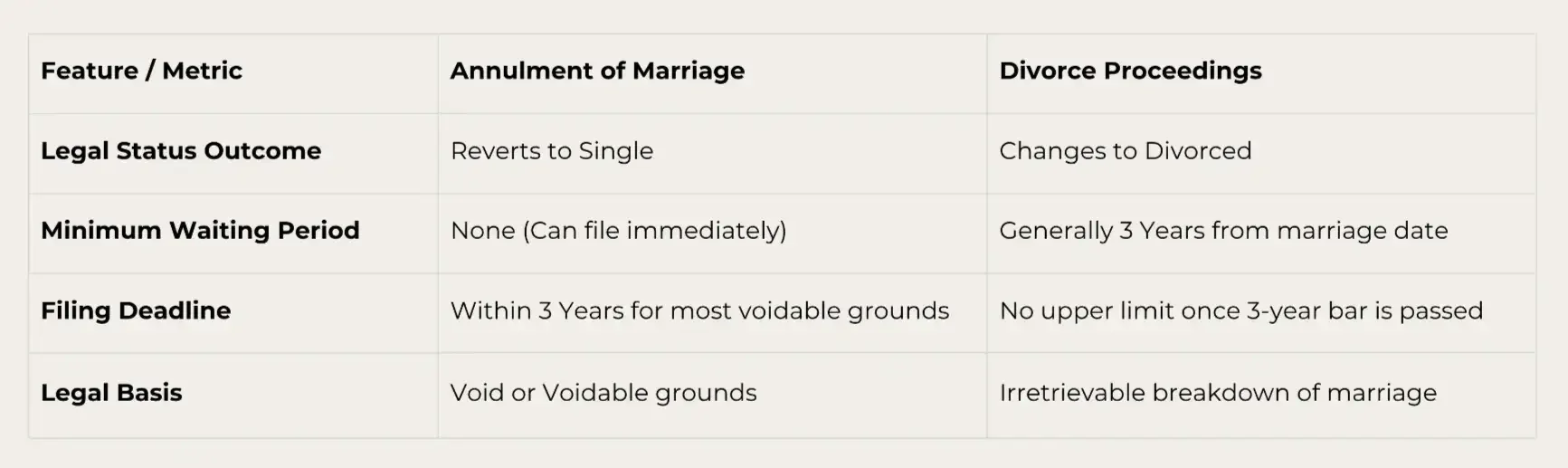
When exploring an annulment of marriage Singapore option, remember that it retroactively erases the legal existence of the marriage. It treats the union as if it never happened. This contrasts with a standard divorce, which dissolves a valid marriage. To understand if your situation fits an early-stage divorce or a nullity claim, you can review our guide on divorce in Singapore.
Reverting to Single Status: Can You Remarry After an Annulment?
Because the court effectively voids the union, both parties return to a single status. This is a primary benefit for many applicants. You do not have to declare yourself "Divorced" on future Registry of Marriages (ROM) applications, allowing you to legally declare your status as single.
Is it Better to Divorce or Annul Your Marriage?
Choosing between these paths is dictated by strict statutory criteria under the Women's Charter, not personal preference. The criteria for an annulment of marriage Singapore are set by law. Some situations may suggest an annulment is possible, while others leave divorce as the only option.
As a quick guide: Annulment is usually the right path only if something was wrong with the marriage from the very start, such as non-consummation, lack of consent, or a technical validity issue, and you're within the relevant time limit. If the marriage was valid but has since broken down, divorce (including Divorce by Mutual Agreement) is the only option, regardless of how the relationship changed over time.
Legal Grounds: When Can a Marriage Be Annulled?
A marriage can be annulled in Singapore only if it qualifies as void or voidable under Sections 105 and 106 of the Women's Charter. The sections below set out exactly which situations qualify.
The Primary Grounds of a Void Marriage (Legally Invalid from the Outset)
Under Section 105 of the Women's Charter, a void marriage appears to be invalid from day one. Valid reasons for an annulment of marriage Singapore under this category include:
Bigamy, where a party has a prior subsisting marriage
Prohibited degrees of relationship, such as incestuous unions
Underage marriages conducted without a valid legal licence
Improper solemnisation, including a lack of two witnesses or an unauthorised solemnizer
Marriages between two people of the same sex, unless one party has undergone a legally recognised sex reassignment
Marriages between two Muslims solemnised under the Women's Charter instead of Muslim law, which falls under the Syariah Court's jurisdiction
Understanding Voidable Marriages: Non-Consummation and Impotence
Section 106 defines a voidable marriage, which remains valid until an Interim Judgment is issued. A common ground is the complete failure to consummate the marriage. This is likely to stem from either a physical or psychological impotence, or a flat wilful refusal to consummate by the other party.
Other Voidable Reasons: Lack of Consent, Fraud, and Undisclosed Conditions
A marriage can also be annulled if there was a lack of valid consent due to duress, mistake, or mental unsoundness at the time of the wedding. Other conditions include a spouse suffering from a communicable sexually transmitted disease, or a wife being pregnant by another man without the husband's knowledge.
Debunking Common Myths About Annulment Grounds
This section dispels common misunderstandings regarding adultery, sexless relationships, and how civil laws differ from religious court rulings.
Is Adultery or Cheating a Valid Reason for Annulment?
Cheating during a marriage forms a factual basis for divorce, not annulment. An annulment of marriage Singapore focuses strictly on defects present at the exact time of entering the marriage contract. Extramarital affairs after the wedding do not invalidate the original legal contract itself.
Is a Sexless Marriage or Intentionally Unconsummated Marriage Grounds?
The legal details matter here. If a marriage was successfully consummated even once, a subsequent sexless phase does not qualify for an annulment. The issue must stem from an absolute failure to consummate from day one, which points back to incapacity or wilful refusal.
Civil Annulment vs. Why a Catholic Annulment Might Be Denied
State law through the Family Justice Courts operates under the Women's Charter. This is completely separate from ecclesiastical law via a Catholic Church Tribunal. A civil annulment does not guarantee a religious one, as church tribunals apply separate canonical grounds that might lead to a denial.
What Happens to Property, HDB Flats, and Finances After an Annulment?
Even though annulment treats a marriage as if it never existed, the court can still make orders on matrimonial assets, maintenance, and, where relevant, an HDB flat bought during the marriage. If you purchased an HDB flat under a scheme tied to your married status, you may need to return the flat to HDB if you no longer meet that scheme's eligibility conditions once the marriage is annulled. The court typically addresses these ancillary matters, including asset division and maintenance, as part of the annulment proceedings, similar to how they're handled in a divorce.
Because outcomes vary significantly depending on your HDB scheme, flat type, and financial circumstances, this is an area where speaking to a family lawyer early makes a real difference.
Key Timelines and Jurisdictional Eligibility Requirements
Understanding the strict residency rules and statutory deadlines is essential before initiating an annulment of marriage Singapore application.
Who Qualifies to File for an Annulment in Singapore?
At the time of filing, at least one party must be domiciled in Singapore or have been habitually resident here for at least three years immediately preceding the application, the same baseline that applies to divorce. Annulment has one additional route divorce doesn't: if neither party meets that threshold, the court can still hear the case if both spouses are residing in Singapore together at the time of filing.
The Strict 3-Year Deadline for Voidable Marriages
Couples seeking an annulment of marriage Singapore on voidable grounds must file a Writ of Nullity within three years of the marriage date. This applies to cases of fraud, lack of consent, or undisclosed medical conditions. Failing to act within this timeline is likely to block your application, though non-consummation cases face an exception to this rule.
The Legal Process: How to Apply for a Writ of Nullity
This part details the practical court documentation, standard timelines, and cost structures involved when formalising a marriage nullity.
Step-by-Step Process: Filing and Core Court Documents
The process requires specific legal documents submitted to the Family Justice Courts:
Drafting and filing a formal Writ of Nullity
Submitting a Statement of Claim outlining your specific legal grounds
Submitting a Statement of Particulars containing the factual evidence
Where to File and How Long the Process Takes
Applications are filed in the Family Justice Courts. An uncontested track, where your spouse completely agrees to the grounds, typically takes four to six months to reach a Final Judgment. A contested track involves complex court hearings and takes notably longer.
Can You Get an Annulment Without the Other Person’s Agreement?
You can file without their prior agreement, but a contested annulment is harder to manage. If the defendant disputes your claims, the judge decides based on evidence. An application can be denied if there is a lack of clear proof or evidence of collusion.
Average Costs of Contested vs Uncontested Annulments
Legal fees depend on whether your case is processed on an uncontested or contested basis. At 21 Chambers LLC, fixed and transparent rates apply so you can manage costs without hidden surprises:
First Consultation Legal Advice: $300 per hour
Uncontested Applications: Starts from $888 (without additional terms) and $1,088 (with ancillary terms included)
Contested Applications: Starts from $7,000, reflecting the additional court work and evidence required for disputed cases
Your exact fee quote and detailed scope of work are typically confirmed upfront once your legal representative evaluates your specific grounds and determines whether your spouse intends to contest the application.
Frequently Asked Questions
Can you get an annulment after a divorce?
No. Once a marriage has been legally dissolved through divorce, there's no longer a valid marriage in existence to annul. Annulment challenges whether a marriage was ever valid, but that question becomes moot once a divorce has already ended it. If you believe your marriage was void or voidable, this is something to raise before or during divorce proceedings, not after, so it's worth speaking to a lawyer as early as possible.
Is annulment harder to get than divorce?
Generally, yes. Annulment requires you to prove your marriage falls squarely within one of the specific void or voidable grounds under the Women's Charter, often with supporting evidence like medical reports or proof of duress. Divorce, particularly through Divorce by Mutual Agreement, only requires both spouses agreeing the marriage has broken down, with no need to prove a technical defect from the outset.
When to Speak with a Family Lawyer in Singapore
Navigating the legal grounds of a nullity claim requires careful handling of evidence. If you want to clarify what path is suitable for your situation, consider reaching out to a professional. You can contact us to schedule a private consultation.
For guidance tailored to your situation, WhatsApp +65 8011 2121 or follow @21chamberssg on Instagram for updates and insights.
Published on: 29 July 2026
Updated on: 01 August 2026