
Separation vs Divorce in Singapore: Which Should You Choose?
Published on: 29 July 2026 | Modified on: 05 August 2026Separation keeps you legally married while living apart; divorce ends the marriage and allows remarriage. Both paths carry dating risks and require clear financial agreements to protect your interests.
Going through a marriage breakdown is incredibly challenging, and trying to navigate legal jargon only adds to that stress. We frequently see clients who are trying to understand separation vs divorce and what each option means for their family. To help you navigate this challenging chapter, here is a clear guide to your legal options under Singapore law.
Separation vs Divorce: What's the Real Difference?
The main difference between separation and divorce in Singapore comes down to legal status. Separation means you live apart while maintaining your married status. Divorce is the legal end of your marriage, severing financial ties and allowing you to remarry.
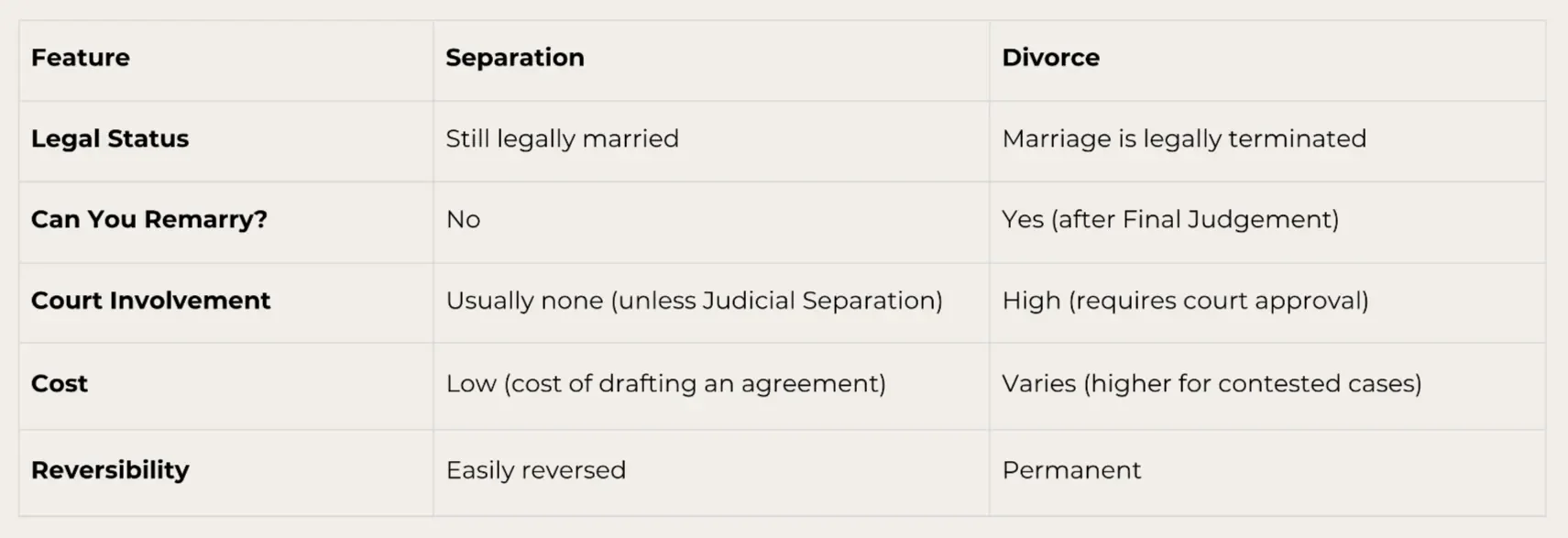
Quick Self-Check: Separation or Divorce?
Before diving into the details, ask yourself these three questions. Your answers point you toward the right starting path, though your family lawyer should confirm the final decision.
Do you both agree the marriage is over? If yes, you likely qualify for Divorce by Mutual Agreement and can proceed directly to divorce without a separation period. If you're still unsure, or your spouse isn't ready, separation gives you time and structure without forcing an irreversible decision.
Do you want the option to remarry? Only divorce allows this. Separation, no matter how long it lasts, keeps you legally married, so remarriage isn't possible until a court grants Final Judgement.
Is a religious or cultural belief stopping you from divorcing? Judicial Separation lets you formalise a legal split, including financial and custody arrangements, without dissolving the marriage itself.
If your answers point toward divorce, jump to Using Separation as a Path to Divorce below. If you're leaning toward separation, or still weighing both, the sections ahead walk through your rights, risks, and first steps in detail.
Are You Still Legally Married During Separation?
As the self-check above notes, separation doesn't change your legal status; you remain married until a court grants Final Judgement. But this has consequences beyond remarriage that are worth understanding: it directly affects taxation, property ownership, and next-of-kin rights in emergency situations.
The Three Types of Separation in Singapore
Spouses who choose to live apart in Singapore generally rely on three main structures: informal arrangements, contractual agreements, or formal court orders. Each option offers varying levels of legal protection and certainty.
Informal Separation
Informal separation occurs when spouses choose to live in separate homes, or live separate lives under one roof, without drafting legal papers. While simple, it leaves finances and child arrangements legally undefined.
Deed of Separation
A Deed of Separation is a binding contract drafted by a solicitor. It sets out specific arrangements for child custody, spousal support, and property management during the separation. Learn more in our detailed guide on the Deed of Separation: When and Why to Use One.
Judicial Separation
Judicial Separation is a formal court order decreeing that the spouses are no longer obliged to cohabit. It is less common and is primarily used by individuals who face strong religious objections to divorce but require court-enforced financial or custody orders.
Why Do Couples Separate But Not Divorce?
Couples choose separation over divorce for a range of practical, financial, and personal reasons. Common reasons include:
Religious or cultural beliefs — that treat divorce as unacceptable, making Judicial Separation a way to formalise a split without violating those beliefs.
Uncertainty about the marriage — separation offers a lower-stakes way to live apart while deciding if reconciliation is possible.
Financial practicality — an amicable Deed of Separation is far less costly than a contested divorce, especially if both parties aren't ready to fully divide assets.
Protecting children from prolonged conflict — separation can reduce day-to-day tension while parents work out longer-term custody and access arrangements.
Insurance, healthcare, or immigration considerations — some couples remain legally married to preserve benefits tied to marital status, such as spousal healthcare coverage or a dependant's visa.
None of these reasons are permanent commitments. Many couples who separate for these reasons eventually move to divorce, particularly now that Divorce by Mutual Agreement in Singapore offers a faster route once both parties are ready.
Is It Better to Divorce or Stay Separated?
There's no universal answer as it depends on your certainty about the relationship, your financial situation, and whether remarriage matters to you. Broadly, separation suits couples who need time, face religious or cultural constraints, or aren't ready to fully sever finances. Divorce suits couples who are certain the marriage is over and want legal and financial closure. Choosing between divorce and long-term separation depends heavily on your financial circumstances and emotional readiness. Staying separated offers a pause, but it brings unique challenges over time.
The Disadvantages of Staying Separated Long-Term
Remaining separated for years creates lingering financial entanglement. Complications often arise if a spouse takes on new debt or acquires new assets, as courts may still treat these as matrimonial property under the law. We also frequently see the "grey divorce" phenomenon, where couples separate late in life but remain in an emotional limbo, lacking the clear closure needed to move forward with their lives.
Can a “Cooling-Off" Period Save a Marriage?
A separation can serve as a practical cooling-off period. It gives couples breathing room to assess the relationship without daily household conflict. Marital counselling during this time often helps couples communicate more clearly, whether that leads to reconciliation or confirms the marriage has broken down. Courts also increasingly encourage this step, since the 2024 Divorce by Mutual Agreement reforms, judges can direct couples toward mediation, counselling, or family support programmes before finalising a divorce.
Dating, Finances, and Staying "Single" While Separated
While you may feel single during a separation, you are still legally married. This carries two important legal realities under Singapore law:
Dating Risks: Starting a new relationship before your divorce is finalised carries legal risks, as your spouse could potentially cite it as adultery or unreasonable behaviour in court.
Financial Ties: Your assets and liabilities remain legally intertwined. Until you have a formal deed of separation or a court order in place, your financial independence is not fully protected.
What Happens If You're Separated But Not Divorced?
While you are separated, your marriage is still legally intact, which means both spouses retain specific legal rights and obligations under Singapore law. Understanding interim maintenance and separation limits helps protect your interests before a formal divorce begins.
Rights to Financial Support During a Separation
Even before a divorce is finalised, a dependent spouse and children are legally protected and retain their rights to financial support under Singapore law. If you are living separately, the court can grant interim maintenance to ensure that your daily living expenses and household needs are fully covered. These legal protections are vital for maintaining financial stability and security for your family before any formal divorce proceedings begin.
Custody and Access to Children During Separation
Separation does not automatically decide who your children live with or how access is arranged. Unless you and your spouse agree on informal arrangements, either parent can apply to the Family Justice Courts for interim custody, care and control, or access orders while the separation is ongoing. Courts prioritise the children's welfare above either parent's preference, and arrangements made during separation often carry weight if the case later proceeds to divorce.
Using Separation as a Path to Divorce
Separation serves as a recognised legal pathway to show that a marriage has broken down in Singapore. Couples can rely on a multi-year separation period to obtain a divorce, or choose alternative options that do not require living apart first.
Proving Your Marriage Has Broken Down
Under the Singapore Women's Charter, separation is a legally recognised fact used to prove that a marriage has irretrievably broken down. If you choose this legal pathway, the timeline required depends entirely on your spouse’s agreement:
Three Years of Separation: Under Section 94 of the Women's Charter 1961, you can file for divorce after three years of continuous separation if your spouse consents. Furthermore, s.94 of the Women's Charter 1961 strictly prohibits filing for divorce under any ground, including DMA, before completing three years of marriage, unless the court grants special leave for exceptional hardship.
Four Years of Separation: If your spouse does not consent to the split or contests the application, you must show that you have lived separately for a continuous period of at least four years before you can proceed.
No Prior Separation Needed: Divorce by Mutual Agreement (DMA)
There is no fixed legal limit on how long you can remain separated in Singapore, and you could theoretically stay separated indefinitely. However, a new legal option introduced on 1 July 2024 allows couples to file for Divorce by Mutual Agreement (DMA) without needing to separate beforehand. If both you and your spouse agree that the marriage is over, this new pathway allows you to proceed with a divorce without needing to fulfill a multi-year separation period first, giving you significantly more flexibility.
Contested vs Uncontested
The path your legal journey takes depends entirely on how much you and your spouse can agree on from the start. To help you weigh your options, here is how the two main routes differ in practice:
Uncontested Divorce: Both parties agree on the divorce and all related matters. This avoids a lengthy trial, lowers emotional strain, and is the most cost-effective route.
Contested Divorce: Parties cannot agree on issues like asset division or child custody. This requires court intervention, multiple hearings, and a longer timeline to resolve.
Timelines, Costs, and Protecting Yourself
The duration and expense of dissolving a marriage vary widely based on your chosen legal route and the complexity of your family's assets.
How Long Does the Process Take?
Realistically, an uncontested divorce might conclude in four to six months. In contrast, a contested divorce is likely to span 12 to 18 months. Cases involving complex matrimonial assets or intense child custody disputes can easily extend well beyond this timeframe as court schedules fill up.
Understanding Legal Costs
Legal fees depend heavily on the path you choose. At 21 Chambers, drafting a simple Deed of Separation or filing an uncontested divorce starts from $888 (without contested terms) or $1,088 (with agreed terms), keeping costs predictable for straightforward cases. A fully litigated contested divorce typically starts from $7,000 and rises with the number of hearings and the complexity of the assets involved. Initial consultations are charged at a transparent $300 per hour, with no free-advice sessions, so you know your costs upfront before committing to a path.
First Steps to Take When Considering Separation
Protect yourself by acting methodically. Gather your financial documents early. Secure an independent bank account for your personal use. Prioritise your children's well-being and daily routines. Finally, seek preliminary legal counsel from 21 Chambers LLC to explore whether drafting a Deed of Separation or initiating formal proceedings is the right step for your family.
When to Speak with a Family Lawyer in Singapore
Taking the first step to speak with a professional early on can help you avoid costly missteps and find some much-needed clarity during a confusing time. Family law is rarely straightforward, and it is completely normal to feel overwhelmed. Reaching out for objective advice is simply a practical way to protect your rights and understand your options before making any big decisions. Contact 21 Chambers LLC to discuss your situation in confidence.
For guidance tailored to your situation, WhatsApp +65 8011 2121 or follow @21chamberssg on Instagram for updates and insights.
Published on: 29 July 2026
Updated on: 01 August 2026